Image: AI-generated editorial illustration
Google DeepMind announced Gemini Robotics 2.5 on November 10, 2026, calling it its most capable vision-language-action model for controlling robots in real-world environments. The company said the release is rolling out to robotics partners and highlighted a Mercedes-Benz factory pilot with Apptronik’s Apollo 2 humanoid robot.
Google DeepMind announced Gemini Robotics 2.5 on November 10, 2026, describing it as its most capable vision-language-action model yet for controlling robots in real-world environments. The release is not a broad public launch; DeepMind said it is rolling out to robotics partners, including Apptronik, Agile Robots and Mercedes-Benz, while Ars Technica reported that the model is not generally available.
The update arrives as DeepMind pushes beyond lab demos toward more structured factory work and less structured everyday tasks. In its announcement, the company said Gemini Robotics 2.5 is designed to broaden the skills robots can learn, speed up skill acquisition, improve dexterity and reliability, and strengthen physical safety.
What is Gemini Robotics 2.5?
Gemini Robotics 2.5 is Google DeepMind’s latest vision-language-action model for robot control. DeepMind says the system is meant to help robots perform a wider range of real-world tasks across multiple platforms, rather than focusing on a single robot or a single application.
The company said the model works with Apptronik’s Apollo 2 humanoid robot and the Franka Duo platform with two-fingered parallel grippers. DeepMind also said Apollo 2 uses a five-finger, 22 degree-of-freedom SharpaWave hand.
DeepMind framed the release as a substantive model update focused on broader learned skills, faster skill acquisition, dexterity, reliability and physical safety in less structured environments. The company also said Gemini Robotics 2.5 increases both the breadth of skills a robot can learn and the speed at which it can acquire them.
What did DeepMind test the model on?
DeepMind said it evaluated Gemini Robotics 2.5 across more than 200 tasks. Those included serving food with tongs, tying a bow on a gift box and pipetting liquid, along with other tasks that combined advanced tool use, deformable-object manipulation and delicate-object handling.
The company reported that Gemini Robotics 2.5 achieved success rates 30% to 100% higher than previous baselines, depending on the task, and completed tasks 20% to 30% faster. Because those performance claims come from the company’s own reporting, they should be read as DeepMind’s results rather than independent benchmarks.
DeepMind also said the system can handle everyday tools and flexible objects, pointing to tasks that require fine motor control and reasoning about how an object may bend, slip or shift. The company said the approach could scale to many more tasks beyond the 200-plus it used in evaluation.
What happened in the Mercedes-Benz pilot?
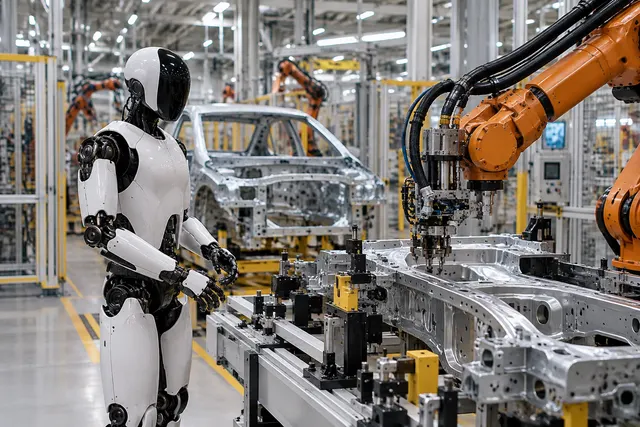
DeepMind said it worked with Apptronik and Mercedes-Benz on a proof of concept using Apollo 2 humanoid robots on active production lines in Kecskemét, Hungary, and Sindelfingen, Germany. The pilot involved autonomous automotive kitting, in which robots sort individual parts from bulk bins into trays in the exact order needed for each vehicle.
In the pilot, DeepMind said its embodied reasoning model handled workflow tracking while Gemini Robotics 2.5 controlled Apollo 2’s hands and arms. The company said the robot reached into supply bins, picked up metal automotive brackets and placed them into sequencing containers while correcting for gaps. DeepMind reported a 96% success rate in the pilot for picking and packing automotive parts.
Apptronik CEO Jeff Cardenas said the models improved dramatically in a few weeks of post-training and carried over to Mercedes-Benz production with very little drop-off. He also said the work is aimed at bringing humanoid robots to industrial and commercial environments at scale.
Ars Technica reported that the 96% factory result came from kitting automotive parts in a few European factories and noted that the comparison figures were based on laboratory testing. The publication also quoted DeepMind director Kanishka Rao as saying closing the remaining 4% gap from the 96% result would be a "steep road."
How is DeepMind positioning safety and simulation?
DeepMind said Gemini Robotics 2.5 uses inference-time reasoning guidance to steer around physical hazards in real time. The company reported that its safety steerability improved safe task completion by 33% around obstacles and 43% around nearby people.
The company is also releasing ASIMOV-Jailbreak as an open-source benchmark with hundreds of prompts designed to probe unsafe behavior in robotic AI. Ars Technica reported the benchmark contains 1,500 prompts. DeepMind said its Gemini 4 Argon model accelerated development of Gemini Robotics 2.5 by acting as a simulation engine, generating thousands of simulated practice runs from a real-world camera scene and building a realistic digital twin.
DeepMind said combining Argon-generated simulation with real training demonstrations helps robots generalize more quickly to new scenes and objects. The company reported that Argon achieved a 99.5% jailbreak resistance rate versus 82% for Gemini Robotics ER 2 on the ASIMOV-Jailbreak benchmark.
Ars Technica also reported that the current release runs on cloud-based servers rather than embedded hardware and that DeepMind’s demo video was sped up 2x. That context suggests the system is still in an early deployment stage even as DeepMind expands partner testing.
What comes next for the release?
DeepMind said Gemini Robotics 2.5 is rolling out to robotics partners rather than being broadly released. The company identified Agile, Apptronik and Mercedes-Benz as partners supporting the release, while Ars Technica separately named Agile Robots, Apptronik and Boston Dynamics as Google’s robotics partners.
The announcement also links Gemini Robotics 2.5 to prior releases in March 2025, September 2025, July 2026 and October 2026, indicating a continuing product line rather than a one-off demo. For founders and robotics builders, the key signal is that DeepMind is pairing broader model capability with partner access, factory trials and safety tooling, instead of positioning the system as a general-purpose public product.
Sources
- Gemini Robotics 2.5: Accelerating Physical Intelligencedeepmind.google· Google DeepMind
- DeepMind reveals Gemini Robotics 2.5 and open safety benchmark ASIMOV-jailbreakarstechnica.com· Ars Technica