Image: AI-generated editorial illustration
Ultra announced on October 9, 2026 that it raised $62 million across two rounds as it looks to scale its warehouse robots and deepen a partnership with Physical Intelligence. The Brooklyn startup said the capital will go toward engineering and broader adoption of its OP1 Operator system, which handles warehouse workflows such as packing, sorting and kitting.
What did Ultra announce on October 9?
Ultra announced $62 million in funding on October 9, 2026, split across two rounds: a $50 million Series A led by Framework Ventures and an earlier $12 million seed round. Fortune reported that Y Combinator participated in the Series A, while the seed round was jointly led by Y Combinator and NextView Ventures. The same report said the Brooklyn-based startup also disclosed a deeper partnership with Physical Intelligence alongside the financing.
SiliconANGLE reported that Ultra raised the money over two rounds and plans to use it for engineering initiatives and broader adoption of its warehouse robots. Ultra’s official X account said it was announcing $62 million in funding, including the $50 million Series A.
What does Ultra sell?
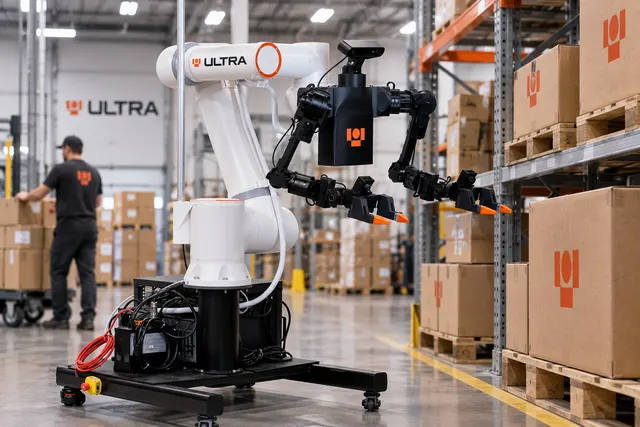
Ultra sells a warehouse robot called OP1 Operator, a system SiliconANGLE described as resembling a humanoid robot attached to the end of a traditional robotic arm. The robot uses a pair of grippers shaped like forklift prongs and has a vertical reach of up to 10 feet, which lets it take merchandise off warehouse shelves. The company says the robot can also pick up items that fall to the ground.
According to SiliconANGLE, OP1 Operator handles warehouse workflows including separating mixed inbound container contents into single-item bins, kitting, and final packaging. In kitting mode, it combines items from different containers into the same parcel. The robot can also place items into a package, seal it and add a shipping label. Ultra says OP1 Operator supports multiple packaging types, including envelopes and plastic bags.
Ultra’s X account said in June that OP1 is stationary rather than mobile, but can move around an entire work cell, reach up to 10 feet high and plug into the wall to run continuously. In the October 9 announcement, the company said it believes deployment is the bottleneck in robotics.
How is Ultra deploying the robot?
Ultra says OP1 Operator is mounted on a flat base with wheels, and workers move it manually between warehouse sections before the wheels lock in place. The robot plugs into a standard wall outlet rather than using batteries, and a second cable connects it to the local network. SiliconANGLE reported that the robot’s onboard computer shares sensor data with other robots over that network connection.
The company’s public positioning and Y Combinator listing both emphasize rapid installation and practical deployment. Y Combinator says Ultra builds practical, general-purpose robots for repetitive industrial tasks, designed to be installed in hours rather than weeks and trained quickly on repetitive work. YC also says Ultra uses off-the-shelf hardware to focus on rapid deployment and that its robots already operate in the field, generating revenue and data.
Why are Ultra and Physical Intelligence working together?
Fortune reported that Ultra builds and installs the robots while Physical Intelligence supplies the AI software. The two companies’ relationship is meant to give Physical Intelligence real-world data to train its models. Fortune said Physical Intelligence was valued at $5.6 billion and was founded by a team from Google DeepMind.
Ultra says it uses robot data to improve the AI models that power its hardware, and that its models do not require extensive customer configuration. SiliconANGLE reported that the company says OP1 Operator can be set up in a few hours. Fortune also reported that Ultra has deployed robots in warehouses across the U.S. and, according to the company, has packed more than 500,000 orders.
Fortune described Ultra as a robots-as-a-service business that leases devices to warehouses under a monthly model. The publication said Ultra specializes in installing robots at 3PL sites to pack goods for transit and charges customers an upfront integration fee plus a monthly fee for hardware and software support. Ultra CEO Jon Miller Schwartz told Fortune the company has booked significant revenue, though he did not disclose the amount, and said Ultra has been able to raise prices.
Wing VC said on X that it invested in Ultra and that the company’s robots are already running in 3PL warehouses across the U.S. and automating order packaging. Y Combinator lists Ultra as founded in 2024 and part of its Summer 2024 batch, and says the startup plans to rapidly scale deployments in 2026.
Sources
- Wing VC (@Wing_VC) / Xx.com· X
- Ultra raises $62 million for fast-growing ‘robots as a service’ business, announces tie-up with AI research firm Physical Intelligencefortune.com· Fortune
- Ultra raises $62 million for fast-growing ‘robots as a service’ business, announces tie-up with AI research firm Physical Intelligencefortune.com· Fortune
- Warehouse robot maker Ultra Robotics bags $62Msiliconangle.com· SiliconANGLE
- Ultra (@Ultraroboticsco) / Xx.com· X
- Ultra: Practical, general-purpose robots for repetitive ...ycombinator.com· Y Combinator