Image: AI-generated editorial illustration
Furientis announced a $25 million seed round led by Benchmark on October 6, 2026, as the defense startup also said it had secured its first funded government contract for interceptor development.
Furientis announced a $25 million seed round led by Benchmark on October 6, 2026, and said the financing was paired with its first funded government contract: a prototyping Other Transaction Agreement with the Department of War. Benchmark partner Chetan Puttagunta is joining the company’s board as part of the deal.
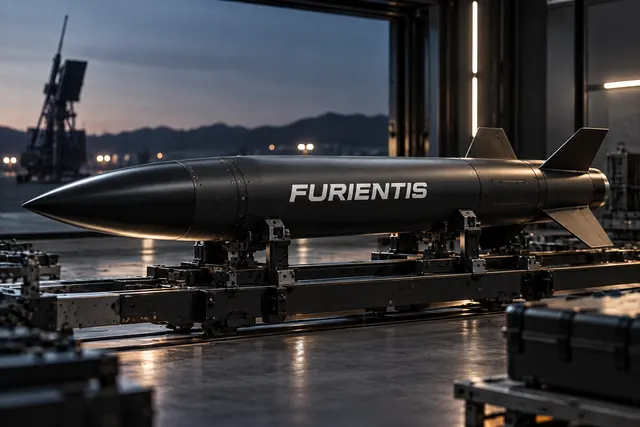
The company says the new capital and contract proceeds will support vertically integrated manufacturing, expanded flight-testing, and hiring in engineering and manufacturing in Los Angeles. Furientis is building interceptor missiles designed for manufacturability at scale, and the OTA funds development of its 100-mile-range interceptor vehicle for homeland defense.
The round also extends a short funding history for the startup. Furientis said it had previously raised a $5 million pre-seed round announced in May. TechCrunch, as republished by Yahoo Finance, reported that the company is about one year old and was valued at $125 million by a person familiar with the company when the seed round was announced.
What is Furientis building?
Furientis is building missile interceptors, with the company saying its focus is not on best-in-class performance alone but on manufacturing at scale and at lower cost. CEO Brody Franzen said the company’s purpose is to address shortages in defensive munitions, and that Furientis views the problem primarily as one of production and manufacturing.
According to the company, its design process starts with prototypes rather than years of conceptual work before first flight. Furientis said each design choice is judged by whether a part can be made at 1,000 per year per factory and whether final assembly can be completed in under an hour. The company also said it uses commercial off-the-shelf parts where possible and makes its solid rocket motors and seekers in-house.
Furientis’ website says its F1.0 Tactical Interceptor vertically integrates the seeker, CAS, airframe and rocket motor, and that its propulsion approach uses a proprietary solid rocket motor chemistry optimized for production throughput. The company also says it was founded in May 2025 by lifelong rocket enthusiasts.
Why did Benchmark back the company?
Benchmark’s Chetan Puttagunta said Furientis built prototypes using its pre-seed financing and had completed about a dozen launches before Benchmark invested. He said the company aims to build a rapidly scalable platform at the lowest cost in the world.
Franzen said the founders started Furientis after concluding the U.S. military lacked enough expensive interceptor missiles to counter cheaper threats. In comments reported by Yahoo Finance, he said the U.S. Navy receives 300 to 500 interceptor missiles annually, while China claims output of 3,000 anti-ship cruise missiles a month. He said the U.S. was being outproduced by more than 100 times.
The company is operating in a crowded defense market. Franzen said Anduril, Castelion, and Shield AI are among the companies also racing to build mass-produced interceptors.
What does the government contract cover?
Furientis said its first funded government contract is a prototyping Other Transaction Agreement with the Department of War. The OTA funds development of the company’s 100-mile-range interceptor vehicle and covers a contract period during which Furientis is expected to demonstrate the flight vehicle’s performance against department requirements.
That contract fits the company’s broader pitch: build interceptors that can be manufactured quickly, in volume and at low cost, while the company says it will demonstrate performance against department requirements under the OTA. Furientis said recent events showed the threat is real and that the U.S. is running low on systems protecting the American people.
The company also said U.S. defense manufacturing is optimized for high performance rather than affordable mass production. It plans to keep testing prototypes first, rather than spending years in conceptual design, and says it has been testing missiles in the field every two weeks.
What happens next for Furientis?
Furientis said the new funding and contract proceeds will go toward vertically integrated manufacturing, more flight testing, and engineering and manufacturing hires in Los Angeles. TechCrunch reported that the company’s longer-term factory goal is 1,000 systems per year per factory, and that it is taking prototypes from Los Angeles to White Sands, New Mexico, for trial launches.
The seed round marks Benchmark’s first bet on a pure defense startup, according to Yahoo Finance’s reporting of TechCrunch. For Furientis, the next phase appears to be proving that its production-oriented approach can scale into a repeatable manufacturing system while it continues to test the interceptor against government requirements.
Sources
- Furientis lands $25M from Benchmark to mass-produce low-cost missile interceptorsfinance.yahoo.com· Yahoo Finance
- Furientis — Intercepting Tomorrow's Threats, Todayfurientis.com· Furientis
- Updatesfurientis.com· Furientis
- Furientis lands $25M from Benchmark to mass-produce low-cost missile interceptorstechcrunch.com· TechCrunch
- Furientis Awarded First Funded Government Contract with Department of Warfinance.yahoo.com· Yahoo Finance