Image: AI-generated editorial illustration
Mueon announced on October 15, 2026 that it raised $65 million in Series A funding for Cubelets, its modular compute-and-memory platform aimed at AI and hyperscale infrastructure. Maverick Silicon led the round, with Intel Capital, Geodesic Alliances Fund, Oregon Venture Fund, M-Ventures, Wellington Capital, IQT and Defined participating.
Mueon announced on October 15, 2026 that it raised a $65 million Series A to expand Cubelets, its modular compute-and-memory platform for AI and hyperscale infrastructure. The Portland, Oregon semiconductor-systems company said the financing is intended to push the product toward broader system validation and production readiness while it expands engineering and operations and deepens customer engagements.
Who led Mueon’s Series A?
Maverick Silicon led the round, according to the company announcement. Intel Capital, Geodesic Alliances Fund, Oregon Venture Fund, M-Ventures, Wellington Capital, IQT and Defined also participated. Unite.AI reported that Mueon said Manish Muthal of Maverick Silicon and Srini Ananth of Intel Capital would join its board as part of the financing.
The company did not disclose a valuation in the supplied reporting. It also did not provide a closing structure beyond describing the transaction as a Series A financing.
What is Cubelets?
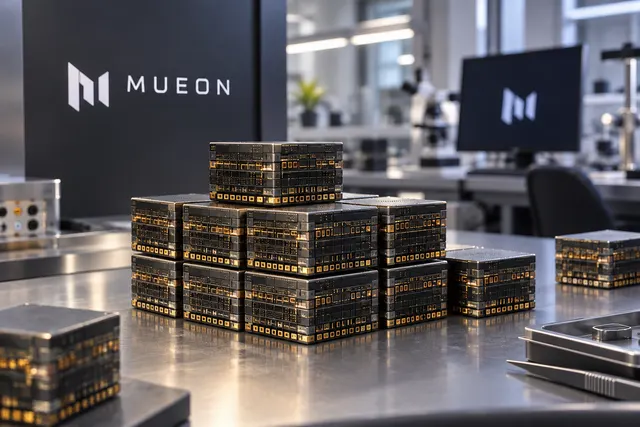
Mueon describes Cubelets as modular, three-dimensional building blocks that integrate compute and memory, with packaging, interconnect, power and thermals treated as core design variables. In the company’s framing, the system is not tied to any single accelerator technology and is built around the constraints that shape AI infrastructure economics, especially data movement, power density and deployment limits.
RuntimeWire said the effort is aimed at modularizing data-center infrastructure beyond chip-level optimization, and noted that Mueon’s efficiency figures remain targets rather than published results. The company said Cubelets is designed to shorten how far data travels and reduce the power cost of moving it.
What will Mueon do with the money?
Mueon said the new capital will support four execution tracks. The first covers silicon and system architecture work across compute, memory and interconnect. The second focuses on advanced integration, including packaging, power delivery and thermal methods intended to raise compute density. The third centers on software and system orchestration so the hardware can fit existing AI frameworks and workflows. The fourth is ecosystem validation, with partners testing components, integration choices and the path from prototype to production.
The company said it is targeting up to 10x gains in power and cost efficiency within the same rack footprint and is designing the architecture to scale toward megawatt-class density. Those figures were presented as targets, not independently published outcomes.
What comes next for Mueon?
Mueon said the financing brings its total capital raised to more than $80 million, following a $15.5 million seed round announced in 2025. At seed, the company said it was focused on AI inference and training workloads constrained by rack-based systems and that it was collaborating with fabrication, manufacturing and foundry partners to validate Cubelets and move it toward market.
Unite.AI reported that Mueon launched from stealth on September 17, 2025 and that Intel Capital led its seed round, with participation from Geodesic Alliance Fund and Oregon Venture Fund. In the latest round, Mueon CEO Wilfred Gomes said the financing is intended to bring its compute and memory system-scale integration technology to market.
The company also said Ampere Computing is working with it as it reduces technical risk on the way to production. Intel Capital’s Srini Ananth said Mueon is reimagining data-center design by unifying compute, memory, power delivery and thermal management in one integrated system. d-Matrix co-founder and CTO Sudeep Bhoja said Cubelets could pair with in-memory compute to enable smaller, denser AI infrastructure.
Sources
- Mueon Raises $65M Series A to Move Cubelets Toward Production Readinessunite.ai· United AI
- Mueon raises $65M to validate modular AI data center systemsruntimewire.com· RuntimeWire
- Mueon Raises $65M in Series A Funding to Scale its Cubelets™ Exponential Computing Platformmorningstar.com· PR Newswire via MorningstarUnverified URL