Image: AI-generated editorial illustration
Minerva Humanoids emerged from stealth on October 6, 2026 with about $10 million in pre-seed funding led by General Catalyst, as the Germany-based startup prepares Roger for hazardous industrial and public-safety work and targets first paid pilots in fall 2026.
What did Minerva announce?
Minerva Humanoids emerged from stealth on October 6, 2026 with about $10 million in pre-seed funding led by General Catalyst. The Germany-based humanoid robot company said the round also included Long Journey Ventures and Credo Ventures as co-leads, with participation from angels including Hugging Face co-founder Thomas Wolf and OpenAI’s Laura Modiano, according to reporting from Tectonic Defense and Humanoids Daily.
Minerva said the capital will be used to finalize Roger, its humanoid robot for demanding work, and to build out semi-autonomous capabilities. The company also said it plans to raise another round soon to scale production next year.
What is Roger built to do?
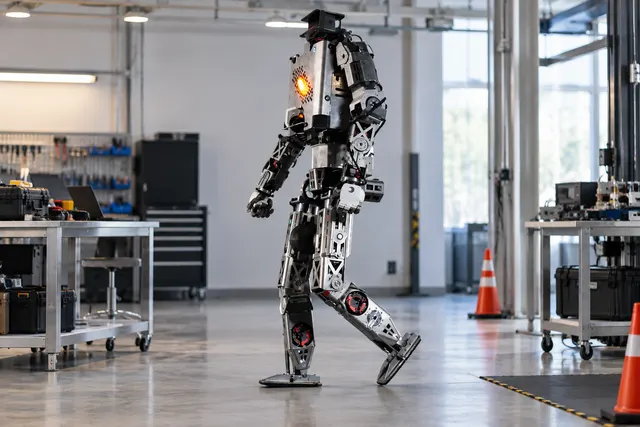
Roger is designed for hazardous industrial and public-safety work, including oil and gas refineries, offshore chemical units, biological hazards labs, bomb disposal and drone disposal, according to Minerva’s website and reporting by Tectonic Defense. The company describes the robot as intended for industrial and public-safety environments and says its public-safety use cases include emergency response to toxic gas alarms, leaks or fire watch while humans remain behind the muster line.
In oil and gas, Minerva says Roger is aimed at tasks such as operating valves, turning levers and pressing buttons. The company also lists scheduled line walkdowns for condition monitoring as a use case. On its public-safety page, Minerva presents interactive demonstrations and an operator-view walkthrough of Roger’s missions.
How does Minerva say Roger works?
Minerva is not pitching full autonomy. Instead, the company says Roger uses shared autonomy, pairing a remote human operator with onboard software that handles balance, fall recovery and navigation to operator-selected waypoints. Minerva’s website says teleoperation includes camera view, body tracking and haptic feedback between robot and operator, while reporting from Tectonic Defense said the human operator wears a VR headset and will soon use haptic gloves as AI corrects weight, balance and precise movement.
Humanoids Daily reported that if communications are lost, Roger can adopt a safe pose, while autonomous return-to-base is still in development. The same outlet said Minerva Intelligence handles balance, fall recovery and navigation, and that the human operator provides the high-level intelligence. Interesting Engineering reported that operators can learn full-body control of Roger within minutes, though the robot remains a prototype.
What milestones and customers come next?
Minerva said its first paid oil and gas pilot is planned for fall 2026, with operational service contracts targeted for 2027. The company has also said it expects to scale production next year after another fundraising round.
Reporting from Humanoids Daily said Roger moved from a clean-sheet design in March 2026 to a walking prototype in August. Tectonic Defense said Minerva completed a fully mechanical Roger prototype earlier in 2026 and then a fully functional electromagnetic prototype, with three prototypes named Roger 1, Roger 2 and Roger 3. The company has also said software and AI development is primarily based in the United States, while prototype manufacturing and assembly take place near Stuttgart, Germany, with production planned in both Germany and the U.S.
Minerva’s backers said the company has been working with German actuator suppliers, and Tectonic Defense reported that Felber said the startup uses no single-source Chinese parts and maintains a Western supply chain. The company also said it has research partnerships with MBZUAI for energy applications and the University of Waterloo for perception in smoke, darkness and sensor failure.
On the defense side, Tectonic Defense reported that Minerva has tested prototypes with the FBI and NATO DIANA and expects a pilot with the Ukrainian Ministry of Defense. Interesting Engineering also said the company demonstrated its technology at the NATO Explosive Ordnance Disposal Centre of Excellence in Slovakia before the public launch. Minerva’s founders, Sandor Felber and Maurice Rahme, founded the company in 2025; Rahme previously spent six years at Boston Dynamics, including as technical lead on Stretch.
Sources
- Minerva Humanoids Emerges from Stealth with $10M Led by GCtectonicdefense.com· Tectonic Defense
- Minerva Emerges From Stealth With $10M for Humanoids Built for Dangerous Jobshumanoidsdaily.com· Humanoids Daily
- New humanoid robot built in five months remotely handles bombs, hazardous energy jobsinterestingengineering.com· Interesting Engineering
- Minerva Humanoids | Meet Rogerminervahumanoids.com· Minerva Humanoids
- Public Safety | Minerva Humanoidsminervahumanoids.com· Minerva Humanoids