Image: AI-generated editorial illustration
Cosmoserve Space said it raised a $6 million seed round led by Japan-based Rebright Partners, with investors including Aranya Holdings, Naandi Ventures, AUM Ventures and Shakti VC.
Hyderabad-based spacetech startup Cosmoserve Space announced a $6 million seed round on November 5, 2026, led by Japan-based Rebright Partners, with Aranya Holdings, Naandi Ventures, AUM Ventures and Shakti VC participating. The round takes the company’s total reported capital raised to more than $9 million, after an earlier $3.17 million pre-seed round reported by Indian Startup Times.
Cosmoserve said the new money will support Base 1, technology demonstrations and two upcoming missions. The company also said it had not disclosed the round’s valuation or investor stakes.
What will Cosmoserve use the seed round for?
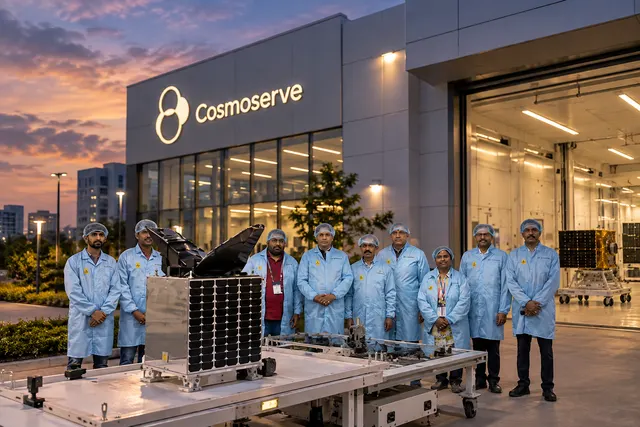
Cosmoserve said the capital will go toward Base 1, technology demonstrations and two upcoming missions. The new facility is in VSD Tech Park, Gachibowli, and spans about 14,800 square feet, according to IPO Central. Cosmoserve described Base 1 as India’s first private facility and the sixth in the world with space vision effects and microgravity simulation.
The site includes an orbital rendezvous and capture lab, a space robotics lab, an ISO Class 8 clean room and a mission simulation and control centre. Cosmoserve said the facility is intended to support in-orbit repairs and refuelling as well as debris removal. Union Minister Jitendra Singh and Telangana IT Minister D Sridhar Babu attended the opening.
Who participated in Cosmoserve’s seed round?
Rebright Partners led the seed round, and the company said Aranya Holdings, Naandi Ventures, AUM Ventures and Shakti VC also participated. SMEStreet said Rebright Partners described this as its first spacetech investment, while AUM Ventures said it was deepening its investment in Cosmoserve.
IPO Central reported that Cosmoserve had previously raised a $3.17 million pre-seed round in September 2025 led by angel investor Alan Rutledge through US-based AVCF. Siliconindia said that earlier round was oversubscribed and included AUM Ventures and Shakti VC. IPO Central also said Cosmoserve was founded in June 2025 and had raised more than $9 million in about 17 months.
What is Cosmoserve building for in-orbit servicing?
Cosmoserve is developing satellite servicing and debris removal technology built around a soft robotic capture system that uses flexible robotic petals for irregular or tumbling objects. It is also building a vision-based navigation system. IPO Central said the company’s model uses a larger Orbital Service Station and a smaller Autonomous Service Vehicle, and that Cosmoserve claims the two spacecraft could service up to 100 satellites, compared with the usual one-spacecraft-per-target approach.
The company estimates servicing costs could fall from about $10 million to below $1 million per satellite. Cosmoserve also cited an estimated 28,000 satellites in orbit, nearly 10,000 of them dead or not working, along with about 660 collisions and explosions that have produced nearly 58,000 tracked fragments.
Cosmoserve and cited reports point to a growing market for debris removal and satellite servicing. Business Standard said the company cited an estimated 1.3 million new satellites expected to launch over the next decade, while SMEStreet said the global market for debris removal and satellite servicing is projected to reach $14.5 billion by 2030.
What comes next for Cosmoserve?
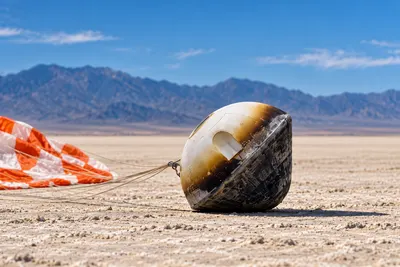
Cosmoserve’s first payload, Mission Embrace, flew in July 2026 on Skyroot Aerospace’s Vikram-1, which IPO Central said was the first privately developed Indian rocket to place payloads in orbit. Founder Chiranjeevi Phanindra said the flight hardware was built in under four months and cost about INR 1 crore.
IPO Central reported that on Mission Embrace the capture system survived launch and its actuation system and onboard software worked, but the robotic petals did not open in orbit. Based on that result, the reporting said the core capture function had not yet been demonstrated in space. Available reporting said Cosmoserve plans a full-scale debris-capture demonstration in 2027; Business Standard reported a first commercial mission targeted for early 2028, while founder Chiranjeevi Phanindra separately said commercial operations would start by mid-2028.
Cosmoserve said it holds letters of intent from four satellite constellation operators: one from the US, one from Europe and two from India. The company also said about 60% of its mission components are sourced locally, and IPO Central reported that Base 1 is meant to reduce dependence on imported optics, avionics and space-grade electronics.
Phanindra, who worked at ISRO for about 15 years including on Gaganyaan and at the Inter-Agency Space Debris Coordination Committee, previously said Cosmoserve reached Vikram-1 within 11 months of starting operations with a lean team. SMEStreet also reported that Cosmoserve was among 30 startups selected to showcase its technology to French President Emmanuel Macron in the presence of Prime Minister Narendra Modi.
Sources
- Cosmoserve Raises $6 Mn Seed Funding to Advance Satellite Servicing Technologyindianstartuptimes.com· Indian Startup Times
- BREAKING 🚨 Cosmoserve Space raises $6M Seed led by Rebright Partners, with Aranya Holdings, Naandi Ventures, AUM Ventures and Shakti VC, for tech demx.com· @thestartpod on X
- Spacetech Firm Cosmoserve Space Raises ₹56.4 Cr in Seed Round, Opens First Private Space Debris Facility in Hyderabadipocentral.in· IPO Central
- Cosmoserve Opens Base 1 for Satellite Servicing and Debris Removal Facilitysmestreet.in· SMEStreet
- Cosmoserve unveils Hyderabad facility for space debris removal, refuellingbusiness-standard.com· Business Standard
- Cosmoserve Space raises $6 million in seed funding roundsiliconindia.com· Siliconindia