Image: AI-generated editorial illustration
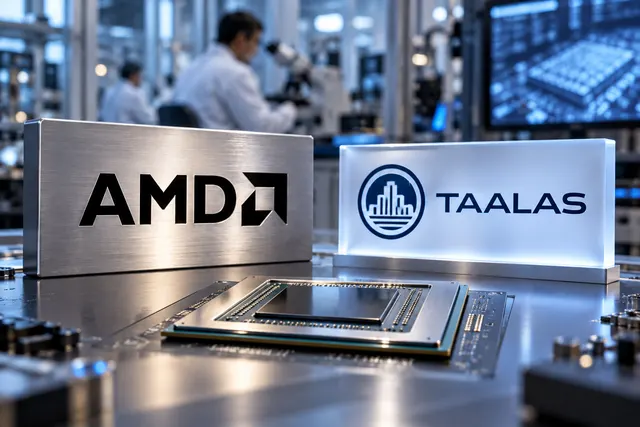
AMD said on November 17, 2026, that it completed its acquisition of Toronto-based Taalas, a startup specializing in AI inference silicon, in a cash-and-stock transaction valued at about $2.9 billion.
AMD has completed its acquisition of Toronto-based Taalas in a cash-and-stock transaction valued at approximately $2.9 billion, the company said on November 17, 2026. The deal includes up to about $1.4 billion in contingent consideration, according to reporting based on AMD’s quarterly SEC filing, and follows an agreement signed in August.
The purchase gives AMD access to a startup focused on specialized silicon for AI inference, the stage where trained models generate answers or carry out tasks. AMD said Taalas strengthens its full-stack AI portfolio and long-term inference roadmap, while outside reporting said the startup’s technology is intended to help customers run AI models faster and more efficiently.
AMD said it plans to integrate Taalas technology into its accelerator roadmap and develop system-level solutions alongside Instinct GPUs, complementing EPYC CPUs, ROCm software and the Helios rack-scale platform. The company also said the acquisition expands its engineering presence in Canada and broadens its technical-talent base.
What did AMD buy, and why?
AMD bought Taalas, a Toronto startup that develops chips specialized for AI inference. AMD described Taalas as "a pioneer in specialized AI inference silicon," and said the company brings technology and engineering expertise aimed at improving performance and efficiency for specialized workloads.
That matters because AI inference is where a model serves real users by generating text, recommendations or other outputs. AMD said demand for AI inference is accelerating, and executive Vamsi Boppana said customers need a broad range of compute solutions optimized for their workloads.
Reporting from Yahoo Finance said Taalas’s chips are designed to reduce compute and memory bottlenecks that can slow general-purpose chips when they are used for inference-heavy workloads. BigGo Finance reported the startup’s core approach is to hardwire model-specific information directly into silicon circuits, with the goal of reducing repeated data exchange between compute units and memory.
How much did AMD pay for Taalas?
AMD and reporting based on its SEC filing put the transaction at about $2.9 billion in cash and stock, including up to approximately $1.4 billion in contingent consideration. That contingent portion is tied to performance conditions, according to BigGo Finance, and reporting noted it makes up nearly half of the reported deal value.
Chosun Daily said the transaction was valued at about $2.9 billion including the contingent consideration, and that AMD signed the acquisition agreement in August before closing it this week. BigGo Finance said the transaction closed on November 17, 2026 local time.
BigGo Finance also reported that the large contingent portion reflects uncertainty around technology commercialization. Some observers, the outlet wrote, expect substantial integration work will be needed before Taalas technology can be commercialized into product lines and win customers.
How will Taalas fit into AMD's AI platform?
AMD said Taalas technology will be folded into its accelerator roadmap and used to develop system-level solutions with Instinct GPUs. The company also said it will complement its broader data-center stack, including EPYC CPUs, ROCm software and the Helios rack-scale platform.
That positioning suggests AMD wants more than a point product. By bringing inference-specific silicon into a broader hardware and software portfolio, the company is aiming to offer customers a more integrated stack for AI deployment, from CPUs and GPUs to software and rack-scale systems.
AMD said the acquisition strengthens its full-stack AI platform and its long-term inference roadmap. It also said the deal expands its engineering footprint in Canada and its technical-talent base, reinforcing a practical benefit beyond the product itself.
What happens next for AMD and Taalas?
AMD said it has not given a timetable for the first systems using Taalas technology. That means the transaction is complete, but commercial integration is still ahead.
For now, AMD said Taalas is now part of its effort to deliver differentiated inference performance and efficiency, while strengthening its full-stack AI platform. The company’s bet is that demand for AI inference will keep rising as AI services expand, making model-tailored chips increasingly important.
Yahoo Finance reported AMD shares rose about 0.8% in Tuesday trading after the announcement, suggesting investors viewed the deal as strategically important even as the commercialization work remains to be done.
Sources
- AMD Stock Rises After Chip Deal Closesfinance.yahoo.com· Yahoo Finance
- AMD acquires Taalas and World Labs to expand AI chip and model developmentbiz.chosun.com· Chosun Daily
- AMD Acquires Taalas for approximately $2.9 Billion, Chasing Nvidia With AI Inference-Specific Chipsfinance.biggo.com· BigGo Finance
- AMD Completes Acquisition of Taalas to Advance AI Inference Innovationnewsroom.amd.com· AMD
- AMD acquires Taalas and World Labs to expand AI chip and model developmentbiz.chosun.com· Chosun Daily