Image: AI-generated editorial illustration
Remanence, a Paris-based startup that helps companies train and own their own AI models using open-weight systems, has raised a $30 million seed round announced on Nov. 17. EQT Ventures and FirstMark led the financing, which the company said is its first, as it comes out of stealth and expands beyond France.
Remanence emerged from stealth on Nov. 17 with a $30 million seed round to help companies turn production AI traces into models they own, rather than relying on closed-source systems. The Paris-based startup said the financing was its first, and available reporting characterizes the transaction as a seed round without disclosing a valuation or confirming whether the round had formally closed.
What does Remanence build?
Remanence builds a platform that uses open-weight technology to help businesses create tailored AI models from their own usage data. Axios reported that the company’s approach is designed to let customers build and own customized models, potentially reducing reliance on closed-source AI systems.
EQT Ventures said Remanence’s product learns from production execution data to identify where AI agents succeed or fail, then automatically generates training environments and evaluations before training specialized models. According to EQT, the system is meant to keep model weights under customer ownership and allow data to remain within the customer’s infrastructure.
Maddyness described a similar workflow, saying the platform integrates with a company’s existing AI models and converts execution traces into custom training environments. As new traces are produced, models can be retrained to improve precision, adapt to workflow changes and lower latency and costs.
Who backed the seed round?
EQT Ventures and FirstMark led the $30 million seed round, according to Axios and EQT Ventures. Other participants included Zero Prime, Emblem, Drysdale, Global Founders Capital and Yellow, along with angel investors.
Maddyness identified angel backers Philippe Corrot, Olivier Pomel, Romain Niccoli and Mehdi Ghissassi. Fortune also reported the round and listed EQT Ventures and FirstMark as the leaders.
EQT said the capital will fund a dedicated GPU cluster in Europe, research and engineering hires mostly in Paris, and an early presence in London and San Francisco. The firm also said Remanence plans to scale design partnerships across Europe and the United States. Maddyness similarly reported that the startup intends to expand computing infrastructure and staff to strengthen its training environments, while opening offices in London and San Francisco.
Why are investors betting on this approach?
EQT Ventures framed Remanence around a growing enterprise pain point: production agents can generate thousands of execution traces per day, and most of that data is discarded. The investor said agentic workloads can increase enterprise AI costs even as per-token prices fall, because the expensive part often becomes the surrounding post-training work rather than the base model call itself.
The firm also said post-training talent is scarce and concentrated among only a few hundred people worldwide. In its view, the hardest part is not the training run itself, but building a sandboxed environment with verifiers, a process that is often still done manually for each customer over months. Remanence’s pitch is to automate that work so the cost of each new deployment does not scale with headcount.
EQT cited Infrared 2026 data saying the share of U.S. enterprises running open-weight models in production rose from 23% to 67% in one year. It also pointed to companies such as Cursor and Ramp, which it said train models with reinforcement learning on their own usage and outperform frontier APIs on their key tasks.
Who founded Remanence?
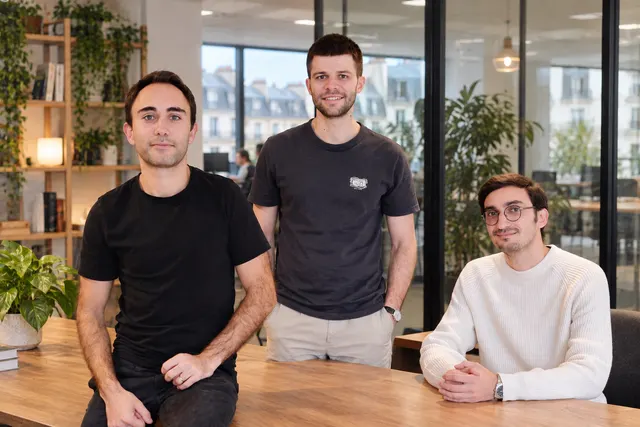
Maddyness said Remanence was founded by three former H Company employees: Pierre-Louis Cedoz, Hamza Benchekroun and Axel Moyal. Cedoz previously worked at Google DeepMind, according to the publication, and Maddyness identified him as H Company’s former CTO.
EQT Ventures said Cedoz was H’s founding researcher and CTO and had previously worked on Gemini post-training at Google DeepMind. The firm said Benchekroun led post-training at H Company and had previously deployed reinforcement learning for industry and biology partners at InstaDeep, while Moyal led agents, evaluations and environment synthesis projects across web, desktop and mobile applications at H.
EQT also said the team’s work at H Company helped secure H’s entry into NVIDIA’s Nemotron Coalition. The investor said the founders previously led post-training work on H Company’s open-weight Holo models, and that in March 2026 Holo reached state-of-the-art performance on OSWorld-Verified ahead of proprietary frontier models at a fraction of their cost. That benchmark claim is being attributed to EQT Ventures.
Remanence and EQT framed the product around enterprise ownership of models trained on company data. Cedoz told Maddyness that Remanence was built to help companies turn data from their AI agents into specialized models they control, and that the ambition is to let every enterprise build proprietary intelligence that improves with use and becomes a durable advantage.
Sources
- The software companies most likely to go private in 2027 and beyond, according to PitchBookfortune.com· Fortune
- IA : des anciens de H Company lancent leur startup avec une levée de fonds de 30 millions de dollarsmaddyness.com· Maddyness
- Own, Don’t Rent AI: Why We Co-Led Remanence’s $30M Seed Roundstories.eqtventures.com· EQT Ventures
- Exclusive: Remanence raises $30M to help companies train their own modelsaxios.com· AxiosUnverified URL